A Practical Proposal for a Sound Design Option Gareth Evans 24004392@uhi.ac.uk
The creative project will take the form of a 2 channel video projection with 2 channel stereo audio and a sculptural installation. Key technological features being audio reactive image creation, adaptive layered soundscapes and acoustically engineered space.
This nonlinear time-based art aims to create an immersive audience experience that disrupts the structures of traditional narratives through constantly evolving dynamic processes. The work is structured as a responsive audiovisual environment in which sound is treated as a generative material rather than accompaniment. Through continuous transformation, the installation encourages individual experiences that are shaped by movement, listening, and interaction within the space.
Visual content is generated in TouchDesigner, where incoming audio is analysed and mapped to multiple visual parameters including geometry, displacement, particle systems, colour, and lighting. Audio is produced and spatialised in Ableton Live, with microphones placed throughout the installation introducing live acoustic data into the system. Rather than triggering predefined events, these inputs continuously influence the behaviour of the audiovisual environment, resulting in a work that remains responsive throughout its presentation.
The work is conceived for underused or redundant spaces within the university, the installation responds to rooms whose original purpose has diminished. Its temporary occupation reframes these overlooked environments as places of encounter, where sound, image, and audience interaction briefly reactivate spaces that exist in a state of transition. The mushroom forms function as recurring motifs of transformation, their biological cycles of growth, decay, and regeneration reflecting the continual evolution of both the audiovisual environment and the spaces it temporarily inhabits.
Research and Development


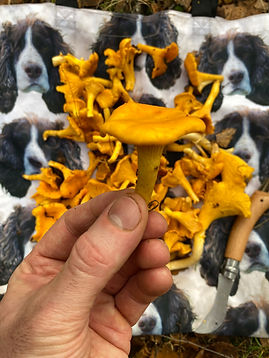
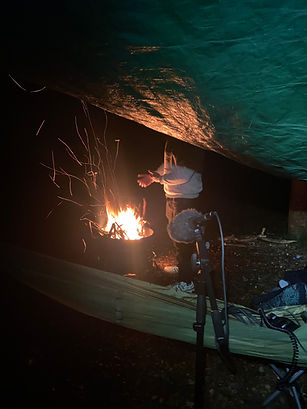
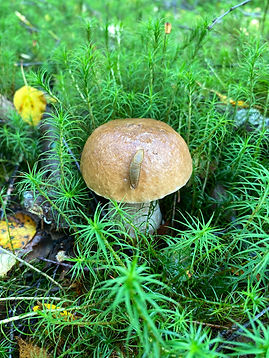
Field recording, processing and foraging.

Chanterelle (Cantharellus cibarius)

Orange Birch Bolette (Leccinum versipelle)

Steinpilz/Cep/Penny Bun (Boletus edulis)

Fly Agaric (Amanita muscaria)

Polypore

Source material rendered as 3d models, imported and cleaned in Blender, transferred to Touchdesigner.
Blender → TouchDesigner
-
OBJ
-
PLY
models generated from Luma scans.
Luma AI ↓
Blender ↓
Clean mesh ↓
TouchDesigner ↓
Audio reactive deformation


Microphones
Microphones distributed around the installation so visitors would become part of the work.
Dynamic and Condenser Microphones to analyse:
-
Overall amplitude
-
Frequency bands
-
Spectral content
-
Transients
-
Noise density
rather than simply using a volume follower.
Those values would then control different aspects of the visuals.
For example:
Audio parameter Visual parameter
Bass energy Geometry scale
Mid frequencies Particle movement
High frequencies Bloom / glow
Amplitude Camera movement
Transients Model switching
Noise floor Colour variation
Microphones
│
▼
Ableton Live (audio processing / composition)
│
├── Audio output → 2-channel speaker system
│
└── Audio analysis / OSC
│
▼
TouchDesigner
│
Real-time visuals / projection
The installation functions as a generative audiovisual system. Live microphone input is analysed and translated into visual and sonic parameters, establishing a continuous feedback process between audience, sound, image, and site. The resulting environment is not pre-scripted, but emerges through real-time interactions between these elements.


